


painting — graphics — etching — photography
Curator: Tatyana Paleeva
East Meets West Gallery
The opening day is January 23 at 6:30 p.m.
January 24 – February 24
The Nikolai Ostrovsky Museum
Tverskaya St., 14
daily, from 9:00 to 20:00
The weekend day is Monday.
+7 903 118 89 32
Between time and the garden
The foundation of all signs and symbols in art lies in the images of living nature, which has surrounded humanity since the time of Eden. Art has, since time immemorial, retold nature and plant‑based subjects, processing, generalizing, and transforming what surrounds humanity into symbols and images. Ancient architectural orders and styles grew out of plant motifs. The language of natural algorithms does not require interpretation or translation; it is truly understandable to everyone without words. The Latin and Cyrillic alphabets bow in reverence before the writings of nature.
The pomegranate, the grapevine, the acanthus leaf, cereals, seeds, the triumph of the flowering of grasses and trees, the bounty of the fruit – from Adam to the present day, the great cycle of existence, from birth to mortal end, is repeated, assuring man of the triumph of endlessly возрождающейся life.
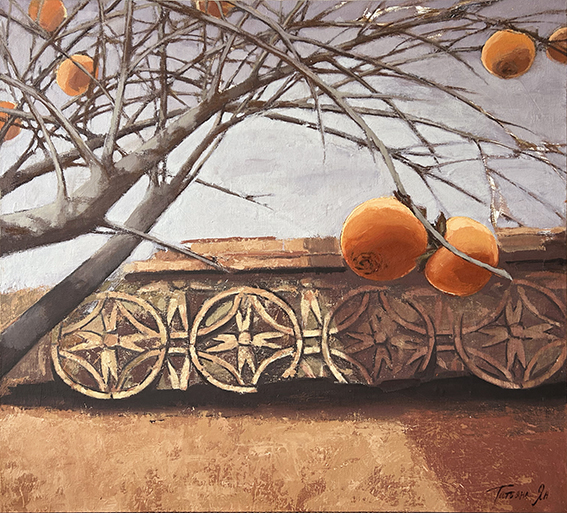
It so happened that my creative life is divided in two between Moscow, my garden, and Rome. But there is something that unites these so different worlds: the motifs of living nature, which are the same in the main thing everywhere. Nature is an inexhaustible source of inspiration for everyone at all times. The blossoming and the weight of the garden’s fruits today are akin to those depicted on the walls of the triclinium at the Villa of Livia, which are more than two millennia old. But there is also a big difference. Thus, in Rome, nature is perceived through the lens of the history of the Eternal City, transformed by the human genius of countless artists and architects over the millennia of history. Here, it is everywhere in fragments of architectural entablature, reliefs and capitals, depicted in ancient frescoes – “natura naturata”. In Russia, however, where the history and cultural tradition are different, nature appears to man in its freedom, untouched, primordial – “natura naturans”. By combining places that are so distant in terms of time and distance in my works, I create for myself a space without time or boundaries, a space that is complex.
This colossal range of meanings and timeframes—from the tender white snow of apple blossoms in an orchard near Moscow to fragments of ancient marbles with floral motifs—captivates the artist, who is enchanted by the grandeur of the art of distant creators and the triumph of nature’s vital force. The dualism of perception that inevitably arises when you travel from Moscow to Rome and then return, intrigues the eye; an irresistible desire arises to unravel, to tell, to depict this enigma.
Tatyana Yan
2025